Table of Contents:
From Iron Ore to Finished Steel: Core Processes and Metallurgical Fundamentals
Steel production is one of the most complex and energy-intensive industrial processes on the planet, yet its fundamental logic follows a clear metallurgical thread: remove impurities, control carbon content, and shape the resulting alloy for specific mechanical properties. Annual global crude steel output consistently exceeds 1.8 billion metric tons, with China alone accounting for roughly 54% of that figure. Understanding what happens at each stage — from raw ore to finished product — is prerequisite knowledge for anyone working seriously in procurement, engineering, or quality assurance within the metals industry. For a solid grounding in the overall workflow, the foundational concepts behind iron and steel production are worth revisiting before diving into process specifics.
Primary Steelmaking: Reducing Iron and Managing Carbon
The journey starts in the blast furnace, where iron ore (predominantly hematite Fe₂O₃ or magnetite Fe₃O₄), coke, and limestone are charged at temperatures exceeding 2,000°C. The output — hot metal or pig iron — contains 3.5–4.5% carbon along with significant sulfur, phosphorus, and silicon levels that render it too brittle for structural use. This hot metal then feeds into one of two primary steelmaking routes: the Basic Oxygen Furnace (BOF), which processes approximately 70% of global steel output, or the Electric Arc Furnace (EAF), which dominates the remaining 30% and relies primarily on recycled scrap rather than virgin ore.
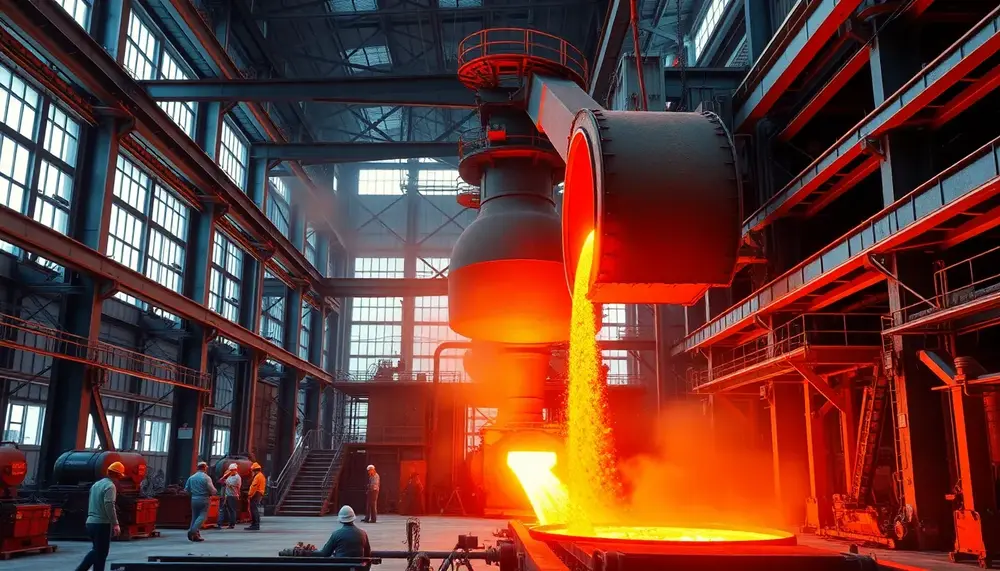
In the BOF, a supersonic oxygen lance blows pure oxygen into the molten iron bath at flow rates around 800–1,000 m³/min. This oxidizes excess carbon — reducing it from ~4% down to under 0.1% in roughly 20 minutes — while simultaneously burning off silicon and manganese into the slag phase. The speed and exothermic nature of the reaction means heat management is critical: the process is largely self-sustaining, but scrap additions (typically 25–30% of the charge) act as a thermal coolant. Getting familiar with key metallurgical terminology like basicity, liquidus, and decarburization helps immensely when communicating with process engineers or interpreting mill certificates.
Secondary Metallurgy and Casting: Where Final Properties Are Set
Once primary steelmaking delivers liquid steel at the target carbon content, secondary metallurgy — also called ladle metallurgy — fine-tunes composition and temperature before casting. This stage involves vacuum degassing (RH or VD units) to strip dissolved hydrogen below 2 ppm, wire injection of calcium or rare earth elements for inclusion modification, and precise alloying additions of Mn, Si, Nb, V, or Ti depending on the end-use specification. Hydrogen content above 4–5 ppm in high-strength steels creates a real risk of hydrogen-induced cracking during or after rolling — a failure mode that no downstream heat treatment can fully reverse.
The refined steel is then cast, predominantly via continuous casting machines that have replaced ingot casting in over 96% of global production. Slab, bloom, or billet formats emerge depending on the downstream rolling schedule. Casting speed, mold oscillation frequency, and secondary cooling intensity all directly influence internal cleanliness and surface quality. The choice of furnace technology upstream has cascading effects on what's achievable here — a point explored in depth when comparing how different furnace designs influence steel quality and process flexibility.
- Blast furnace route: Higher capital cost, suited for large-volume flat products like automotive sheet and heavy plate
- EAF route: Lower CO₂ footprint per ton when powered by renewables, dominant in long products (rebar, sections, wire rod)
- Inclusion control: Cleanliness targets measured via SEP 1570 or ASTM E45 directly affect fatigue life in bearing and spring steels
- Solidification structure: Columnar-to-equiaxed transition in the cast strand affects segregation and macrostructural homogeneity
Mastering these fundamentals gives procurement and quality professionals a decisive advantage: they can interrogate mill process data, challenge non-conformance reports with technical credibility, and specify steels that genuinely match the mechanical demands of their application rather than defaulting to over-specified grades that inflate cost without adding value.
Furnace Technologies Compared: BOF, EAF, and Beyond
Choosing the right furnace technology is one of the most consequential capital decisions a steelmaker faces. The two dominant processes—Basic Oxygen Furnace (BOF) and Electric Arc Furnace (EAF)—operate on fundamentally different metallurgical and economic logic, and conflating them leads to poor investment decisions. A BOF converts liquid hot metal from a blast furnace into steel in roughly 40 minutes, processing heats of 200–350 tonnes and relying on the chemical energy of carbon oxidation rather than external energy input. An EAF melts primarily scrap steel using electrical energy, with heat times ranging from 35 to 60 minutes depending on configuration and charge mix.
The cost structure diverges sharply. BOF operations carry enormous fixed costs—blast furnace infrastructure, coke ovens, sinter plants—that only make sense above roughly 3 million tonnes annual capacity. EAF mills, by contrast, are inherently scalable: a single 150-tonne AC furnace can operate profitably at 600,000–700,000 tonnes per year. This is why mini-mills built around EAF technology have steadily captured flat-rolled markets once considered exclusively BOF territory. Nucor's journey from bar products to hot-rolled coil is the clearest demonstration of that dynamic.
Key Process Parameters That Drive Decisions
The charge mix flexibility of EAFs is frequently underestimated. Modern furnaces can process anything from 100% scrap to blends incorporating 30–40% direct reduced iron (DRI) or hot briquetted iron (HBI), enabling producers to arbitrage raw material markets. BOF operations, by contrast, require hot metal ratios typically above 70%, creating a rigid dependency on blast furnace availability. When a blast furnace campaign ends or must be relined—a process costing $80–150 million and taking 60–90 days—the BOF shop has no productive alternative. Understanding which furnace configurations match specific production strategies is foundational before any capacity planning work begins.
Electrode consumption and electrical energy represent the two largest variable cost lines in EAF steelmaking. Specific energy consumption in well-optimized DC furnaces runs 320–380 kWh per tonne of liquid steel, while older AC designs may consume 420–480 kWh. Electrode consumption typically ranges from 1.2 to 1.8 kg per tonne. These numbers shift meaningfully with scrap quality, degree of pre-heating, and oxygen injection practice—all levers that experienced melt shop managers use systematically.
Emerging Alternatives Worth Watching
Beyond the BOF-EAF binary, two technologies deserve serious attention. Converter steelmaking with DRI-heavy charges is already commercial in the Middle East, where natural gas-based DRI costs undercut scrap by $30–50 per tonne in favorable markets. Hydrogen-based direct reduction coupled with EAF melting—the route pursued by SSAB's HYBRIT project and H2 Green Steel—aims to reduce CO₂ emissions below 100 kg per tonne of steel, against 1,800–2,000 kg for integrated BOF routes. The breadth of available furnace configurations means producers have more genuine optionality than is often recognized.
From an operational standpoint, the push to lower energy intensity is accelerating across both process routes. Scrap pre-heating systems like Consteel and finger shaft furnaces recover off-gas energy to reduce electrical input by 60–100 kWh per tonne—a meaningful efficiency gain that also cuts electrode wear. Integrated producers are retrofitting BOF gas recovery systems to capture chemical energy that was previously flared. The broader trajectory of minimizing energy intensity across the steelmaking value chain is reshaping capital allocation priorities at every major producer.
- BOF advantage: high productivity, low variable cost at scale, superior chemistry control for demanding grades
- EAF advantage: lower capital intensity, feedstock flexibility, carbon footprint 60–70% lower when powered by renewable electricity
- DRI/HBI integration: enables EAF producers to hit the low residual levels required for exposed automotive and electrical steel grades
- Hydrogen DRI: commercially proven at small scale; cost-competitive when green hydrogen falls below $2/kg
The Role of Steelmaking Coal: Supply Chains, Quality Standards, and Coke Production
Steelmaking coal — also called metallurgical or coking coal — is not simply a fuel source. It is a chemical reactant and structural agent without which the blast furnace route to steel production cannot function. Understanding its role requires moving beyond surface-level definitions and examining how quality specifications, logistics realities, and coke chemistry interact under industrial conditions. Anyone looking to understand the full scope of coal's function in the steel industry will quickly realize that this input material drives decisions across the entire value chain.
Quality Standards: What Separates Coking Coal from Thermal Coal
Not all coal is created equal, and the distinction matters enormously in a steelmaking context. Coking coal must exhibit specific rheological properties — most critically, the ability to soften, become plastic, and resolidify into a porous, strong mass called coke when heated in the absence of oxygen. Key quality parameters include:
- Vitrinite reflectance (Ro): Typically between 0.8% and 1.9% for coking coals, with the prime hard coking coal range sitting around 1.1–1.4%
- Volatile matter content: Usually 18–32% for standard coking blends
- Coke Strength after Reaction (CSR): Values above 60 are considered acceptable; premium blast furnaces demand CSR above 65
- Ash content: Kept below 10%, ideally under 8%, to limit slag volumes and energy loss
- Sulfur content: Typically below 0.6% to prevent embrittlement in the finished steel
Blending is standard practice across the industry. Steel mills rarely rely on a single coal origin; instead, metallurgical teams construct blends of hard coking coal, semi-hard, and semi-soft varieties to hit a target coke quality while managing procurement costs. Australian coals from Queensland's Bowen Basin — including brands like Peak Downs and Saraji — are benchmark references for hard coking coal globally, often trading at premiums of $30–60/tonne over semi-soft alternatives.
Supply Chain Dynamics and Procurement Risks
The steelmaking coal supply chain is geographically concentrated and therefore structurally fragile. Australia supplies roughly 55% of seaborne metallurgical coal, followed by the United States, Canada, and Russia. Port infrastructure bottlenecks — as seen after Cyclone Debbie struck Queensland in 2017 and caused a six-week disruption that pushed hard coking coal spot prices from $150/t to over $310/t — illustrate how quickly supply shocks translate into cost volatility. Mills with diversified supply bases and long-term offtake agreements consistently outperform those relying on spot purchases during such events.
Logistics costs are substantial and often underestimated. Freight from Queensland to Japanese or Korean ports runs $15–22/tonne under normal conditions, but vessel availability, port congestion, and canal fees can push that figure significantly higher. Integrated steelmakers increasingly use in-house procurement teams embedded at origin ports to manage quality inspection, blending adjustments, and shipment scheduling in real time. This is a structural advantage that smaller independent mills simply cannot replicate without strategic partnerships.
The coke production step itself — where coal blends are heated to around 1,100°C over 16–20 hours in slot ovens — represents a significant energy and capital commitment. As the industry examines its emissions profile, the pressure on this process is intensifying. For those new to how raw materials flow through a steel plant, it is worth noting that coke serves simultaneously as a fuel, a reducing agent, and a physical support structure within the blast furnace — functions that no current alternative fully replicates at scale. The decarbonization challenge this creates is precisely why cutting energy use at every stage of steelmaking has become a strategic priority rather than an operational afterthought.
Energy Intensity and Decarbonization Strategies in Modern Steel Production
Steel remains one of the most energy-intensive industries on the planet, consuming approximately 8% of global final energy demand and accounting for roughly 7-9% of direct CO₂ emissions worldwide. The average integrated blast furnace-basic oxygen furnace (BF-BOF) route consumes between 17 and 23 GJ per tonne of crude steel, while the electric arc furnace (EAF) route using scrap operates at roughly 4-6 GJ per tonne — a dramatic difference that is reshaping investment decisions across the sector. Understanding where energy is actually lost, and which interventions deliver measurable returns, is the starting point for any credible decarbonization roadmap.
The Energy Profile: Where Losses Accumulate
In integrated steelmaking, the blast furnace alone accounts for roughly 60-70% of total site energy consumption. A substantial share of that energy leaves the process as waste heat — in flue gases, slag, and cooling water — with recovery rates varying widely between 30% and 65% depending on plant vintage and investment level. Top gas recovery turbines, hot blast stove optimization, and coke oven gas utilization are proven measures that leading operators implement systematically. Facilities that have focused on cutting their overall energy footprint through process integration consistently report 8-12% reductions in specific energy consumption within 3-5 years of targeted investment.
The choice of furnace technology is equally decisive. EAF-based production not only reduces energy intensity but also unlocks the ability to shift load dynamically in response to electricity prices — a capability that is becoming commercially significant as grid operators introduce demand-response pricing. A detailed breakdown of how different furnace configurations affect both energy use and metallurgical flexibility is covered in this overview of furnace types and their operational trade-offs.
Decarbonization Levers in Practice
Beyond energy efficiency, structural decarbonization requires interventions at three levels: fuel switching, process redesign, and carbon capture. The most commercially advanced pathway is the transition from coal-based ironmaking to direct reduced iron (DRI) using natural gas or hydrogen. Natural gas-based DRI already cuts CO₂ emissions by approximately 40% versus the BF-BOF route; hydrogen-based DRI, using green hydrogen, can push that reduction above 95% on a well-to-gate basis. HYBRIT in Sweden and H2 Green Steel are the benchmark projects demonstrating industrial feasibility, with the latter targeting 5 million tonnes of near-zero-emission steel annually by 2030.
Carbon capture, utilization and storage (CCUS) remains a complementary pathway — particularly relevant for sites where route conversion is constrained by asset age or feedstock availability. Pilot projects at ArcelorMittal's Ghent facility have demonstrated carbon capture efficiencies above 90% for specific gas streams, though full-scale deployment economics remain sensitive to carbon price trajectories above €80-100 per tonne CO₂. Regional policy environments matter enormously here; the trajectory of UK steelmaking, for example, reflects how policy frameworks and industrial legacy shape the decarbonization options available to domestic producers.
- Energy monitoring systems: Real-time energy management platforms (ISO 50001-aligned) typically identify 3-7% savings within the first year of deployment
- Waste heat recovery: Organic Rankine Cycle (ORC) systems on cooling water streams can generate 2-5 MWe in medium-sized EAF shops
- Scrap optimization: Increasing scrap share in BOF converters by 10 percentage points reduces energy intensity by roughly 1-1.5 GJ/tonne
- Green hydrogen readiness: DRI shaft furnaces being commissioned today should be designed for ≥30% hydrogen co-injection to preserve future flexibility
The practical reality is that most steelmakers will pursue a portfolio approach — incremental efficiency gains financed through operational savings, combined with selective capital investment in route conversion where market conditions and policy support align. The timeline pressure is real: steelmaking assets have 20-40 year lifespans, and investment decisions made between now and 2030 will lock in emission profiles well into the 2050s.
National Steel Industries in Focus: Infrastructure, Policy, and Economic Impact
Steel industries do not operate in a vacuum — they are deeply embedded in national infrastructure strategies, employment ecosystems, and long-term industrial policy frameworks. Understanding how different countries manage, protect, and modernize their steel sectors reveals as much about economic priorities as it does about raw production capacity. The strategic choices governments make around steel have downstream effects on construction, automotive, defense, and energy infrastructure that persist for decades.Policy Levers That Define Competitive Position
Government intervention in steel markets takes many forms: import tariffs, state-owned enterprise support, carbon pricing mechanisms, and direct subsidies for green transition investments. South Korea represents one of the most instructive examples of how deliberate industrial policy can build world-class capacity from near zero. The country's transformation into a global steel powerhouse — driven by POSCO and Hyundai Steel — demonstrates what coordinated public-private investment can achieve over a multi-decade horizon. Anyone analyzing how national policy shapes steel competitiveness should examine how Korea rebuilt its entire manufacturing identity around steelmaking, using export orientation and technology licensing as foundational tools rather than relying on domestic demand alone. Trade policy decisions made in Washington, Brussels, or Beijing ripple immediately into the cost structures of steel producers globally. The U.S. Section 232 tariffs introduced in 2018 — 25% on steel imports — reshaped procurement patterns across North America and forced European and Asian producers to seek alternative markets. Such interventions underscore why steelmakers must maintain dedicated government affairs teams and scenario-planning capabilities.Infrastructure Investment as a Demand Signal
National steel consumption correlates strongly with infrastructure spend cycles. Australia's ongoing investment in rail, port expansion, and renewable energy projects has sustained domestic demand despite a relatively small population base. The industry's structure there — dominated by BlueScope Steel with its Port Kembla operations — reflects a model where a single integrated player must balance export competitiveness with domestic supply obligations. Australia's steelmaking landscape shows how geographic isolation, high energy costs, and proximity to Asian markets create a unique strategic calculus unlike anything seen in European or North American contexts. The United Kingdom presents a contrasting scenario shaped by decades of deindustrialization, privatization, and recent urgency around energy security and green steel transition. With Port Talbot's blast furnace closure marking the end of an era, UK policy is now focused on electric arc furnace investment — but the transition is neither quick nor cheap. The broader structural questions facing British producers are captured well when looking at the UK's steelmaking sector through an operational lens, and the path forward requires balancing decarbonization targets against real employment and supply chain risks. Key policy factors that national steel industries must navigate include:- Carbon border adjustment mechanisms (especially the EU's CBAM, effective 2026) that will revalue steel imports based on embedded emissions
- Energy cost differentials — electricity-intensive EAF production is far more viable in countries with competitive renewable energy tariffs
- Scrap steel availability, which determines how quickly a country can transition away from blast furnace production
- Defense and critical infrastructure mandates that require domestic sourcing regardless of cost
Industrial Evolution and Competitive Positioning: Case Studies from Korea, Australia, and the UK
Studying how different nations built, scaled, and restructured their steel industries reveals fundamental truths about industrial policy, resource leverage, and long-term competitive strategy. Three countries in particular — Korea, Australia, and the United Kingdom — offer strikingly different trajectories that carry direct lessons for analysts, procurement specialists, and policy makers operating in the global steel market today.State-Driven Acceleration vs. Resource-Based Advantage
Korea's transformation from a war-ravaged economy into a global steelmaking powerhouse is arguably the most dramatic industrial story of the 20th century. POSCO, founded in 1968 with World Bank skepticism about its viability, reached an annual crude steel output of over 42 million tonnes by the 2020s. The country's success rested on vertically integrated production models, disciplined capital allocation, and aggressive technology licensing from Japan. What sets Korea apart is the deliberate sequencing: first build capacity at scale, then optimize for quality, then push into high-value product segments like automotive-grade and electrical steel. The full scope of how Korea engineered this industrial leap illustrates why state-aligned investment timelines can outpace market-only approaches in capital-intensive sectors. Australia presents a fundamentally different model. Rather than building on domestic demand or state subsidy, Australian steelmaking grew out of an unmatched raw material endowment — iron ore deposits in the Pilbara and coking coal in Queensland gave producers a structural cost advantage that few competitors could replicate. BlueScope Steel's evolution from BHP Steel demonstrates how resource integration can sustain competitiveness even as labor costs rise. Australia exported approximately 875 million tonnes of iron ore in the 2022–23 fiscal year, yet its domestic steelmaking capacity remains comparatively modest, pointing to a deliberate strategic choice: participate in the value chain where the margin is highest. The complete picture of how Australia positioned itself across the steelmaking value chain is essential reading for anyone assessing resource-to-product strategies.Deindustrialization and the Challenge of Industrial Reinvention
The UK offers the most instructive cautionary case. At its peak in the 1970s, British Steel employed over 200,000 workers and produced roughly 28 million tonnes annually. Today, primary steelmaking capacity has contracted to under 3 million tonnes, with the Port Talbot closure in 2024 marking a pivotal moment in that decline. The causes were structural:- Underinvestment in Basic Oxygen Furnace upgrades through the 1980s and 1990s
- Energy cost differentials that made UK operations uncompetitive against continental peers
- Delayed transition toward Electric Arc Furnace (EAF) technology, which now represents the primary decarbonization pathway
- Inconsistent industrial policy that cycled between privatization and emergency state intervention
FAQ zu General: Complete Guide 2026
What is the focus of the General: Complete Guide 2026?
The General: Complete Guide 2026 aims to provide comprehensive insights into key topics, trends, and strategies relevant for the upcoming year.
Who can benefit from this guide?
This guide is beneficial for industry professionals, business leaders, and anyone interested in staying updated on essential information for 2026.
What major trends will be highlighted?
The guide will cover trends in technology, economy, sustainability, and social change expected to influence various sectors in 2026.
How can readers utilize the insights from the guide?
Readers can implement the insights to make informed decisions, plan strategies, and enhance their competitivity in the market.
Are there any case studies included in the guide?
Yes, the guide includes several case studies that demonstrate successful implementation of the trends and strategies discussed.